Learning Outcomes
i. Identify the levels of ecological organization.
ii. Understand how individual organisms interact with their environment and others at various ecological levels.
iii. Explain the hierarchical structure of ecological organization and the interconnectedness of these levels.
i. Levels of Ecological Organization
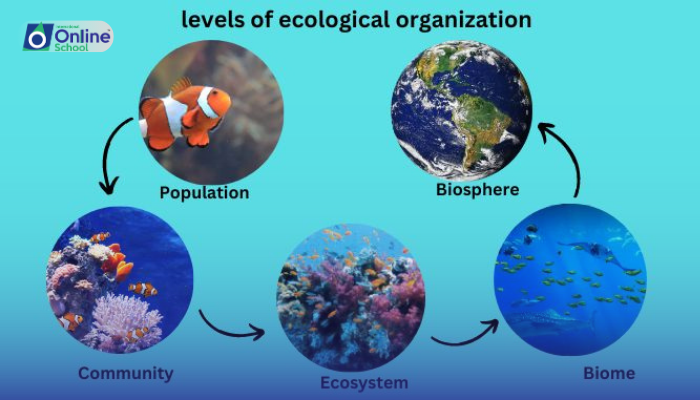
Ecological organization describes the arrangement of biological organisms in relation to one another. At its simplest, this structure can be divided into several hierarchical levels:
Individual: An individual is a single organism capable of independent existence.
Population: A population is a group of individuals of the same species that live in the same area and interbreed.
Community: A community is a collection of populations of different species in an area that interact with each other.
Ecosystem: An ecosystem comprises the biological community plus all the non-living factors influencing that community, known as abiotic factors.
Biome: A biome is a larger area that includes a series of ecosystems sharing similar climate conditions, like rainforests or grasslands.
Biosphere: The biosphere is the global ecological system integrating all living beings and their relationships, including their interaction with the elements of the lithosphere (earth), hydrosphere (water), and atmosphere (air).
ii. Interactions at Various Ecological Levels
Individual Level: At the individual level, organisms interact with their environment in ways that influence their survival and reproduction, such as finding food and avoiding predators.
Population Level: At the population level, organisms of the same species may compete for resources or cooperate for mutual benefit. This level studies population dynamics, distribution, and density.
Community Level: Communities are characterized by interactions between different species, such as predation, competition, and symbiosis, which can shape the structure of the community.
Ecosystem Level: Ecosystems are dynamic and involve interactions among organisms and between organisms and their environments. Energy flows and nutrient cycles are key aspects of these interactions.
Biome Level: At the biome level, climate and geography are major factors that influence the types of ecosystems found in a region and the life forms that the ecosystems can support.
Biosphere Level: The biosphere encompasses all living organisms on Earth, linking all biomes together into a system that sustains life globally through cycles like the carbon and water cycles.
iii. Hierarchical Structure and Interconnectedness
Each level of ecological organization builds upon the previous one, forming a complex and interconnected web that makes up the environment. From individual organisms adapting to their immediate surroundings to global processes that cycle nutrients and energy, each level is interconnected with others in a myriad of ways. For example, a change in a community, such as the introduction of a new species, can have ripple effects through the ecosystem and beyond.
In conclusion, the levels of ecological organization form a hierarchy from individual organisms to the biosphere, with each level having distinct characteristics but also interacting with other levels in complex ways. Understanding these interactions is crucial for appreciating the diversity and interconnectedness of life on Earth.
